
Mound and pressure distribution septic systems in the North Sound
A mound exists because the ground will not take treated wastewater where a conventional drainfield would put it. On a lot in Snohomish, Skagit, or Whatcom County that usually means slow-draining lowland soil, a water table that rises in winter, or a dense layer sitting close to the surface. The answer is to build the drainfield up and pump the wastewater into it instead of letting gravity carry it down.
That decision changes what you own. A gravity system is a tank and some pipe. A pumped system adds a pump, floats, a control panel, an alarm, and a power supply, and Washington puts it on a yearly inspection cycle rather than a three year one.
Why does a North Sound lot end up with a mound instead of a gravity drainfield?
Because the clean soil a drainfield needs underneath it is not there. A drainfield does not finish the job on its own. The last stage of treatment happens in unsaturated native soil below the trenches, and that soil column has to be deep enough and dry enough to work. Where the winter water table comes up into that space, or a compact layer stops water moving through it, the column is missing.
This is ordinary on North Sound ground. Much of the low country here is flat, close to water, and drains slowly, and a site that looks fine in August behaves very differently in February. A system designer settles the question by digging test pits and reading the soil profile: texture, structure, depth to the seasonal high water table, depth to any restrictive layer, and slope. Those readings decide which system types the site can carry.
How does a mound system work?
A mound is a drainfield built above the original ground level, on engineered sand, fed by a pump. Wastewater leaves the house into the septic tank, where solids settle and grease floats, exactly as in any other system. The liquid in the middle then flows into a second chamber, the dose tank, and waits there.
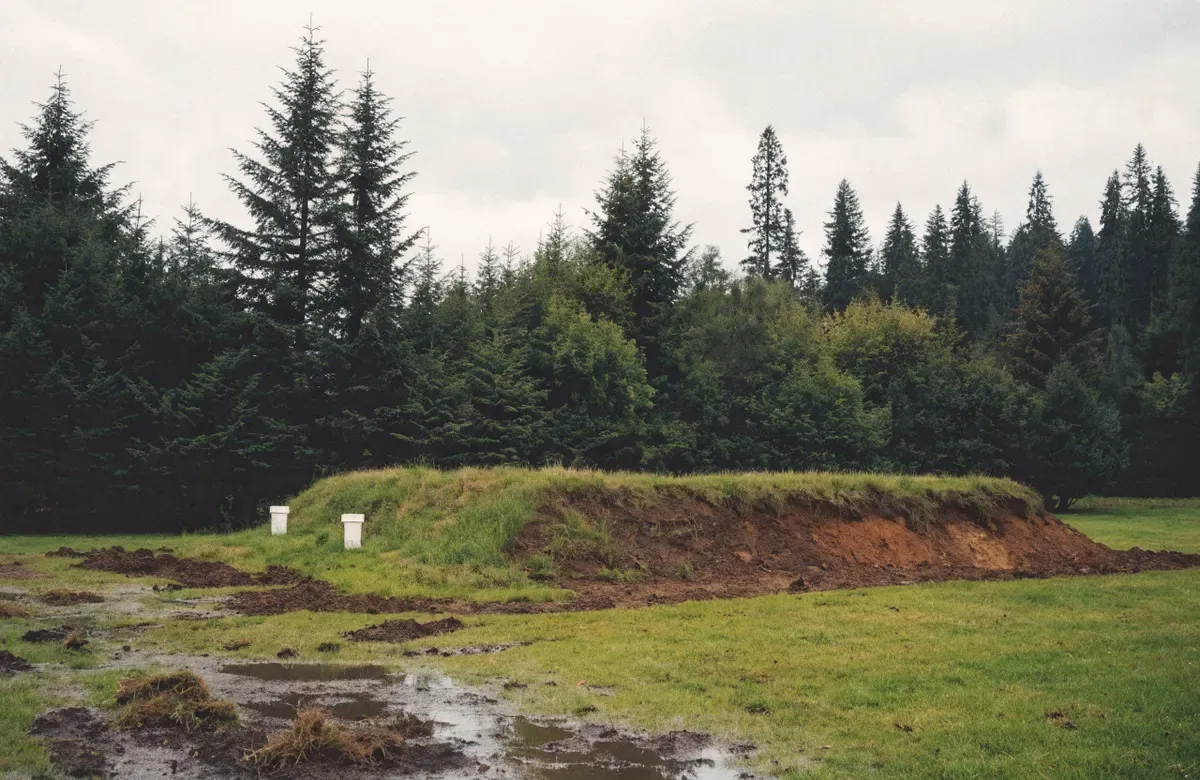
When the dose tank fills to the level a float is set at, the pump switches on and pushes a measured slug of effluent into a network of small pipes buried in the sand. The pipes have drilled orifices along their length, so the dose lands across the whole bed at once rather than at one end of it. It then works down through the sand, which does most of the treatment, and into the native soil underneath. Topsoil and grass cover the finished mound, which is why it reads as a low grassy rise in the yard.
The parts list, in order: septic tank, dose chamber, effluent pump, float switches, a control panel with an alarm, a supply line, the distribution laterals, the sand fill, and the soil cap. An inspector looks at all of them. A homeowner rarely thinks about any of them until the alarm sounds.
How is pressure distribution different from a mound?
A mound is a type of system. Pressure distribution is a method of delivery, and the two get confused constantly. Pressure distribution means a pump pushes effluent through small-diameter pipes with drilled orifices so the entire absorption area receives an even dose at the same moment. Gravity distribution, by contrast, trickles effluent into the first part of the trench and lets it find its own way along.
Almost every mound uses pressure distribution, because pushing effluent uphill needs a pump anyway. But pressure distribution is also used on drainfields at natural grade, on sand filters, and on packaged treatment units, so a property can have one without the other. If you are unsure which you own, the design on file with the county says, and so does your last operation and maintenance report.
Even dosing is the point, not a refinement. Loading the whole bed and then resting it between doses keeps the soil aerobic, and aerobic soil keeps accepting water. Soil that stays saturated stops treating.
What does owning a pumped system actually mean?
More parts, more electricity, more to check. None of it is difficult, but it is not the fit and forget reputation gravity systems have.
- The alarm matters. A control panel alarm normally means the pump is not moving effluent out of the dose tank. Cut water use in the house and call a certified contractor that day. The dose tank has reserve capacity above the working level, and that reserve is what the alarm is spending on your behalf.
- The pump is a wear part. Pumps, floats, and panel components have finite lives and are eventually replaced. That is a septic repair, not a system replacement, and it is a very different scale of job.
- Power outages count. No power means no dosing, so go easy on water until it is back.
- What you flush reaches the pump. Wipes and grease foul pumps, filters, and orifices in a pumped system rather than simply settling in the tank.
- The mound needs to stay a mound. No vehicles, no structures, no trees, and no downspout or driveway runoff aimed at it.
How often does a mound or pressure distribution system have to be inspected?
Once a year. Washington rule WAC 246-272A-0270 sets the routine schedule at at least once every three years for a basic septic tank and drainfield system, and once a year for every other type of system, unless the local health officer requires it more often. A mound, a pressure distribution field, a sand filter, and any other pumped or engineered system all fall outside the basic category, so the yearly line applies to them. Read WAC 246-272A-0270 (checked 2026-09-15).
The counties apply the same split in their own programs. Whatcom County Health and Community Services states that evaluations are required every three years for a conventional gravity system and once a year for every other type, so a Bellingham or Ferndale property on a mound is on the yearly list rather than the three year one. See the Whatcom County operation and maintenance page (checked 2026-09-15). The reminder arrives from the county health department, so the county is the place to confirm your own schedule.
What happens when a mound system comes up at a sale?
There is more to inspect and more paperwork to produce. A transfer inspection on a pumped system covers everything a gravity inspection covers, plus the pump, the floats, the panel, the alarm, and whether the dose volume still matches the design.
In Snohomish County, from November 1, 2026, a seller has to complete a Report of Property Transfer and have the health department accept it before closing. Once accepted it is valid 12 months from the date the health department accepts it, and the seller is the responsible party. If the county holds no as-built record of the system, If the county has no as-built record of the system, a certified septic contractor must draw an On-Site Sewage System Site Plan and it is submitted with the application. See the Snohomish County property transfer page (checked 2026-09-15). An engineered system stands a better chance of having a design already on file, since it needed county approval to be built in the first place, but check rather than assume.
In Whatcom County the report is a Report of System Status, on file with the county when the home is offered for sale, and it must come from an Operations and Maintenance Specialist licensed by the county. A homeowner may not evaluate their own system when the evaluation is for a sale or property transfer. Skagit County requires an operation and maintenance inspection by a certified O and M specialist before any property transfer, unless one was already done in the six months before it. Confirm the specifics with Skagit County Public Health. All three sets of rules sit side by side in the North Sound transfer inspection guide, with detail on the Snohomish County and Whatcom County pages.
What a mound costs, and why there is no number on this page
A mound costs more than a gravity drainfield, to build and to own. It carries a design step, a pump chamber, controls, and a large volume of specified sand that usually has to be trucked in. How much more depends on the design the site forces, machine access, how much fill is needed, and the county issuing the permit. We do not publish a price for that, because any figure here would be a guess a homeowner then plans around. The contractor who sees the site quotes it. Ask for the quote in parts, design, permit, materials, installation, and restoration, because parts compare between bids and a single total does not.
If the mound has already failed
Effluent surfacing around the mound, a permanently wet patch, a returning alarm, or slow drains throughout the house are all reasons to get a certified contractor out before a sale is on a clock. Our guide to a failed septic inspection lays the options out in order, and septic system replacement covers what happens when repair is not the answer.
Common questions about mound and pressure distribution systems
Is a mound system worse than a normal drainfield?
No. It is a different answer to a different piece of ground. Where the water table comes up in winter or a hard layer sits close to the surface, a mound is what makes the lot usable at all. It has more parts, it needs a yearly look, and it costs more to build and to own.
Can I mow, park, or plant on top of a mound?
Mow it once the grass is established. Do not park or drive on it, and do not plant trees or shrubs in it. Vehicles compact the sand and can crush the laterals, roots find the orifices, and runoff aimed at a mound floods the one part of the system that has to stay unsaturated.
What should I do if the alarm on the control panel goes off?
Stop running water and call a septic contractor certified by your county health department the same day. An alarm usually means the pump is not moving effluent out of the dose tank. The tank holds a little reserve space, and that is the warning the alarm is buying you.
Does a mound system have to be inspected every year?
Yes. Washington sets routine inspections at least once every three years for a basic septic tank and drainfield system and once a year for every other type, and anything with a pump falls in the every other type group. Whatcom County already applies the same split, three years for a conventional gravity system and yearly for all the rest.
Get a free quote on a mound or pressure distribution system
Check your septic transfer requirements in the North Sound
Every figure below links to the county or state page it came from, so you can confirm it yourself rather than take our word for it.
The statewide rule that arrives February 1, 2027
Washington rule WAC 246-272A-0270 adds a property transfer inspection statewide beginning February 1, 2027. It has to be done by a third party inspector the local health officer authorizes. Between sales, the same rule sets the routine schedule: at least once every three years for a basic septic tank and drainfield system, and once a year for every other type of system, unless the local health officer requires it more often. Read WAC 246-272A-0270 (checked 2026-09-15).
What your county requires now
-
Snohomish County
Selling a Snohomish County home on a septic system requires a Report of Property Transfer reviewed by the health department before closing.
In force from November 1, 2026.
Who can do it: a certified septic contractor
Who is responsible: the seller.
Timing: 12 months from the date the health department accepts it.
If the county has no as-built record of the system, a certified septic contractor must draw an On-Site Sewage System Site Plan and it is submitted with the application.
-
Skagit County
Skagit County requires an operation and maintenance inspection by a certified O and M specialist before any property transfer, unless one was already done in the six months before it.
Who can do it: a certified operations and maintenance specialist
Timing: an inspection done in the six months before the transfer already satisfies it, so a recent one can carry the sale.
A system with a proprietary treatment product has to be inspected every year by a certified operations and maintenance specialist, separately from anything a sale triggers.
-
Whatcom County
A Whatcom County home offered for sale must have a current Report of System Status, a ROSS, on file with the county.
Who can do it: an Operations and Maintenance Specialist licensed by the county. A homeowner may not evaluate their own system when the evaluation is for a sale or property transfer.
Timing: evaluations are required every three years for a conventional gravity system and once a year for every other type.
How to check the contractor yourself
-
Check the county certification for the work you need
A transfer inspection has to be done by a specialist the county health department certifies for operation and maintenance work. Installing a replacement system is a separate certification. Ask which one the contractor holds, and for which county.
-
Check the contractor registration with Washington Labor and Industries
Every contracting business working in Washington must be registered with L and I, which is a bond and insurance filing rather than a skills exam. You can look up the registration and see whether the bond is active. Verify a contractor with Washington L and I
Three questions worth asking before you hire
- Which county certification do you hold, and does it cover the work my sale actually needs?
- Is the report you produce the one my county health department accepts, and do you file it or do I?
- If the system fails, what are my options, and are you certified to do that repair or replacement too?
What it costs, and what happens after you send it
- What does septic work cost in the North Sound?
- No septic replacement price appears on this site, and that is deliberate rather than an omission. Nothing here is published until it has been read at a primary source, and no verified North Sound replacement figure has been. A range taken from a competitor page or a national average would be a guess wearing a number. Ranges for this work are wide enough to be useless anyway. The gap between the cheapest and the most expensive job on the same road can be several multiples, driven by ground conditions you cannot see from the street. System type is the largest lever, and your land sets it: a gravity drainfield, a pressure distribution system with a pump and control panel, and a raised mound are three different projects, and soil and water table decide which one your lot can take rather than preference. The certified installer who walks the lot is the only honest source of that number, and in Washington the system designer is a separately licensed role, so ask whether a quote includes the design, the permit, removing the old tank, and restoring the yard. The cost drivers guide walks through all seven, so a real quote makes sense when you have one in front of you.
- How fast will someone get back to me?
- Your request goes to an independent licensed local septic contractor, usually within about an hour during the day. That contractor then contacts you to look at the lot and quote the work on their own schedule.
- What work is covered?
- Property transfer inspections, septic system replacement, new system installation, mound and pressure distribution systems, repair, operation and maintenance, and pumping. See every service.
Only a licensed contractor standing on your property can price your actual system.
What your county actually requires
Tell us the county and what the property needs. The quote is free, and there is no obligation to book the work.
Your request goes straight to one independent local septic contractor certified by your county health department, serving Snohomish, Skagit, or Whatcom county. It does not go to a national lead list.